Transforms RNA-sequencing data into actionable clinical insights with automated reports.


Documentation | umccr.github.io/RNAsum
What is RNAsum?
RNAsum is an R package that integrates whole-genome sequencing (WGS) and whole-transcriptome sequencing (WTS) data to generate comprehensive, interactive HTML reports for cancer patient samples.
Installation
Docker
Recommended for Mac users and anyone who wants a self-contained environment:
# Check https://github.com/umccr/RNAsum/releases for the latest release
VERSION=2.0.4
docker pull ghcr.io/umccr/rnasum:${VERSION}
docker run --rm ghcr.io/umccr/rnasum:${VERSION} rnasum.R --version
docker run --rm ghcr.io/umccr/rnasum:${VERSION} rnasum.R --help
Mount local data directories with -v:
Conda
Use the conda lock file for a pinned, reproducible install. Supported platforms: linux-64, linux-aarch64, osx-64, osx-arm64.
# Check https://github.com/umccr/RNAsum/releases for the latest version
# Set PLATFORM to match your system, e.g.:
#   osx-arm64   (Apple Silicon Mac)
#   osx-64      (Intel Mac)
#   linux-64    (Linux x86_64 / HPC)
#   linux-aarch64 (Linux ARM64)
PLATFORM=osx-arm64
VERSION=2.0.4
LOCK_URL="https://raw.githubusercontent.com/umccr/RNAsum/refs/tags/v${VERSION}/deploy/conda/env/lock/rnasum-${PLATFORM}.lock"
conda create -n rnasum --file "${LOCK_URL}"
conda activate rnasum
rnasum.R --version
rnasum.R --help
Workflow
The pipeline consists of five main components.
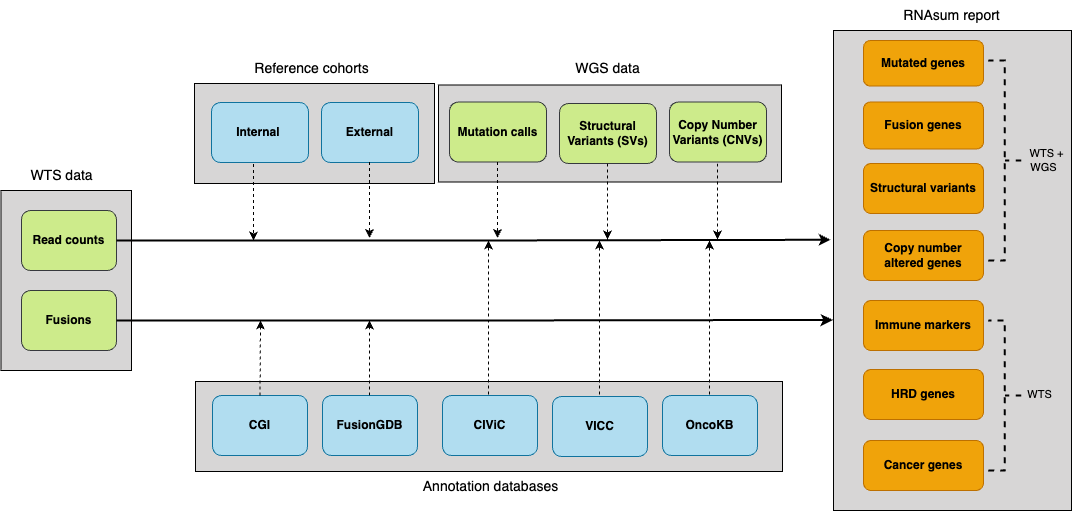
- WTS data collection: ingests per-gene read counts and gene fusions.
- Reference integration: normalises against reference cohorts.
- WGS data integration: links genomic alterations with expression data.
- Knowledge enrichment: annotates with clinically relevant databases.
- Report generation: prioritises findings and creates interactive visualizations.
Usage
Batch effect considerations
When comparing clinical RNA-seq samples to TCGA reference cohorts, batch effects can significantly impact expression rankings due to protocol differences (e.g., ribo-depletion vs poly-A selection, different library preparation methods).
RNAsum provides the --batch_rm parameter to address these differences:
When to use --batch_rm:
- Clinical samples use different RNA-seq protocols than TCGA
- An internal reference cohort was processed with the same protocol
- Expression rankings appear systematically skewed
Alternative approaches:
- Use tissue-matched internal reference cohorts when available
- Consider protocol-specific thresholds for expression classification
- Validate findings with orthogonal methods when possible
Common options
| Option | Description | Default |
|---|---|---|
--sample_name |
Sample identifier | Required |
--dataset |
TCGA reference cohort | PANCAN |
--batch_rm |
Remove batch effects | TRUE |
--salmon |
Salmon quantification file | - |
--kallisto |
Kallisto abundance file | - |
--arriba_tsv |
Arriba fusion detection output | - |
--pcgr_tiers_tsv |
PCGR variant calls (tier 1-4) | - |
--cn_gene_tsv |
Copy number by gene | - |
--filter |
Filter low-expressed genes | TRUE |
Run rnasum.R --help to get complete list of options.
For format and minimal content of input files (e.g. --pcgr_tiers_tsv, --cn_gene_tsv, --sv_tsv), see Input file formats.
Note: human reference genome GRCh38 (Ensembl based annotation version 105) is used for gene annotation by default. GRCh37 is no longer supported.
Examples
Test data: bundled with the package in inst/rawdata/test_data/ Runtime: < 15 minutes (16GB RAM, 1 CPU)
# Locate bundled test data
TESTDATA=$(Rscript -e 'cat(system.file("rawdata/test_data", package="RNAsum"))')
Scenario 1: WGS + WTS (recommended)
Comprehensive reporting, in which WGS-based findings are used as a primary source for expression profile prioritisation.
rnasum.R \
  --sample_name test_sample_WTS \
  --dataset TEST \
  --salmon "${TESTDATA}/dragen/TEST.quant.genes.sf" \
  --arriba_pdf "${TESTDATA}/dragen/arriba/fusions.pdf" \
  --arriba_tsv "${TESTDATA}/dragen/arriba/fusions.tsv" \
  --dragen_fusions "${TESTDATA}/dragen/test_sample_WTS.fusion_candidates.final" \
  --pcgr_tiers_tsv "${TESTDATA}/small_variants/TEST-snvs_indels.tiers.tsv" \
  --cn_gene_tsv "${TESTDATA}/copy_number/TEST.cnv.gene.tsv" \
  --sv_tsv "${TESTDATA}/structural/TEST-sv.tsv" \
  --report_dir /tmp/rnasum_test
The HTML report will be created in /tmp/rnasum_test/.
Scenario 2: WTS only
Basic reporting including information about detected gene fusions and expression levels of key genes.
rnasum.R \
  --sample_name test_sample_WTS \
  --dataset TEST \
  --salmon "${TESTDATA}/dragen/TEST.quant.genes.sf" \
  --arriba_pdf "${TESTDATA}/dragen/arriba/fusions.pdf" \
  --arriba_tsv "${TESTDATA}/dragen/arriba/fusions.tsv" \
  --report_dir /tmp/rnasum_test
The HTML report will be created in /tmp/rnasum_test/.
Ready-made Docker example
A runnable Docker wrapper for Scenario 1 is bundled at inst/scripts/run.sh. It pulls the image, mounts an input and output directory, and runs the WGS + WTS example. All three of VERSION (image tag, see tags), OUTDIR (where the report is written), and INDIR (input data directory) are required. Point INDIR at the bundled test data under inst/rawdata/test_data or at your own inputs:
Batch effects assessment
Assess potential batch effects between the clinical sample and TCGA reference data before running the main analysis. This is particularly important when using different RNA-seq protocols.
Basic setup
The batch assessment functions (assess_batch_effects(), quick_batch_check()) are available directly after library(RNAsum).
Quick start
library(RNAsum)

# Load test sample data (Salmon gene quantification)
test_file <- system.file(
  "rawdata/test_data/dragen/TEST.quant.genes.sf",
  package = "RNAsum"
)
sample_data <- read.delim(test_file)
sample_tpm <- setNames(sample_data$TPM, sample_data$Name)

# Get reference data
ref_paths <- get_refdata(dataset = "TEST", batch_rm = FALSE)
ref_counts <- utils::read.table(
  gzfile(ref_paths$ext_ref$counts),
  header = TRUE,
  sep = "\t",
  row.names = NULL
)
ref_matrix <- as.matrix(ref_counts[, -1])
rownames(ref_matrix) <- ref_counts[[1]]

# Quick assessment using most variable genes (default)
batch_results <- assess_batch_effects(
  sample_data = sample_tpm,
  reference_data = ref_matrix,
  gene_set_type = "top_n",
  n_genes = 2000,
  output_dir = "batch_assessment_results"
)
Assessment interpretation:
-
PCA distance percentile > 95%: High batch effect risk - consider
--batch_rm - Median correlation < 0.7: Substantial protocol differences detected
- Extreme Z-scores > 10%: Expression ranking issues likely
Detailed gene set options and examples
RNAsum provides three gene set options for targeted batch assessment.
Option 1: Top variable genes (default)
# Standard assessment using most variable genes (recommended for general use)
batch_results <- assess_batch_effects(
  sample_data = sample_tpm,
  reference_data = ref_matrix,
  gene_set_type = "top_n", # Uses most variable genes
  n_genes = 2000, # Number of genes to analyze
  protocol_clinical = "ribo-depletion",
  protocol_reference = "TCGA_poly-A",
  output_dir = "batch_assessment_topn"
)
Option 2: Cancer gene set
# Combined cancer genes database (1315 unique genes)
batch_cancer_combined <- assess_batch_effects(
  sample_data = sample_tpm,
  reference_data = ref_matrix,
  gene_set_type = "cancer_genes",
  cancer_gene_source = "combined", # Combined UMCCR + OncoKB databases
  protocol_clinical = "ribo-depletion",
  protocol_reference = "TCGA_poly-A",
  output_dir = "batch_assessment_cancer_combined"
)

# Quick assessment with cancer genes
quick_batch_check(
  sample_data = sample_tpm,
  reference_data = ref_matrix,
  gene_set_type = "cancer_genes",
  cancer_gene_source = "combined",
  save_plots = TRUE
)
Option 3: Custom gene set
# User-defined gene sets (genes must match sample data format)
# Note: Ensure gene IDs match data format (Ensembl IDs vs gene symbols)

# Method 1: Direct Ensembl ID specification
custom_genes_direct <- c(
  "ENSG00000141510",
  "ENSG00000012048",
  "ENSG00000139618"
) # TP53, BRCA1, BRCA2

batch_custom_direct <- assess_batch_effects(
  sample_data = sample_tpm,
  reference_data = ref_matrix,
  gene_set_type = "custom",
  gene_subset = custom_genes_direct,
  protocol_clinical = "ribo-depletion",
  protocol_reference = "TCGA_poly-A",
  output_dir = "batch_assessment_custom_direct"
)

# Method 2: Use cancer genes with automatic conversion (recommended)
batch_cancer_symbols <- assess_batch_effects(
  sample_data = sample_tpm,
  reference_data = ref_matrix,
  gene_set_type = "cancer_genes", # Enhanced: handles symbols automatically
  cancer_gene_source = "combined", # 1315 genes with auto-conversion
  protocol_clinical = "ribo-depletion",
  protocol_reference = "TCGA_poly-A",
  output_dir = "batch_assessment_cancer_auto"
)
Prerequisites for cancer gene sets (Option 2)
For cancer gene set analysis, use the enhanced built-in functionality with automatic format conversion:
- No external files needed - Cancer gene databases and format conversion are built-in
- Automatic gene ID conversion - Handles Ensembl IDs ↔︎ gene symbols transparently
- Three cancer databases available - UMCCR (1248), OncoKB (1019), Combined (1315 genes)
- Smart format detection - Automatically detects and converts incompatible formats
Complete workflow example
Running all three options with TEST data
# Streamlined batch assessment workflow using enhanced functionality
library(RNAsum)

# Load test sample data
test_file <- system.file(
  "rawdata/test_data/dragen/TEST.quant.genes.sf",
  package = "RNAsum"
)
sample_data <- read.delim(test_file)
sample_tpm <- setNames(sample_data$TPM, sample_data$Name)

# Get reference data
ref_paths <- get_refdata(dataset = "TEST", batch_rm = FALSE)
ref_counts <- utils::read.table(
  gzfile(ref_paths$ext_ref$counts),
  header = TRUE,
  sep = "\t",
  row.names = NULL
)
ref_matrix <- as.matrix(ref_counts[, -1])
rownames(ref_matrix) <- ref_counts[[1]]

# OPTION 1: Top variable genes
batch_topn <- assess_batch_effects(
  sample_data = sample_tpm,
  reference_data = ref_matrix,
  gene_set_type = "top_n",
  n_genes = 2000,
  protocol_clinical = "ribo-depletion",
  protocol_reference = "TCGA_poly-A"
)

# OPTION 2: Cancer genes
batch_cancer <- assess_batch_effects(
  sample_data = sample_tpm,
  reference_data = ref_matrix,
  gene_set_type = "cancer_genes",
  cancer_gene_source = "combined",
  protocol_clinical = "ribo-depletion",
  protocol_reference = "TCGA_poly-A"
)

# OPTION 3: Custom genes
custom_ensembl <- c("ENSG00000141510", "ENSG00000012048", "ENSG00000139618") # TP53, BRCA1, BRCA2
batch_custom <- assess_batch_effects(
  sample_data = sample_tpm,
  reference_data = ref_matrix,
  gene_set_type = "custom",
  gene_subset = custom_ensembl,
  protocol_clinical = "ribo-depletion",
  protocol_reference = "TCGA_poly-A"
)

# Compare results
cat("=== Enhanced Batch Assessment Results ===\n")
cat(
  "Top genes analysis: ",
  round(batch_topn$pca_results$distance_percentile * 100, 1),
  "% PCA distance percentile\n"
)
cat(
  "Cancer genes analysis: ",
  round(batch_cancer$pca_results$distance_percentile * 100, 1),
  "% PCA distance percentile\n"
)
cat(
  "Custom genes analysis: ",
  round(batch_custom$pca_results$distance_percentile * 100, 1),
  "% PCA distance percentile\n"
)
What’s in the report?
RNAsum generates an interactive HTML report with the following core sections:
- Findings summary: summary of genes listed across various report sections
- Mutated genes: expression of genes with somatic mutations (requires WGS)
- Fusion genes: detected gene fusions with functional annotations
- Structural variants: expression of genes located within structural variants (requires WGS)
- CN altered genes: expression in CN-gained/lost regions (requires WGS)
- Cancer genes: expression of cancer-associated genes
Available reference datasets
RNAsum includes 33 TCGA cancer type cohorts for comparative analysis:
| Cancer Type | Dataset Code | Samples |
|---|---|---|
| Pan-Cancer | PANCAN |
330 |
| Breast Invasive Carcinoma | BRCA |
300 |
| Lung Adenocarcinoma | LUAD |
300 |
| Pancreatic Adenocarcinoma | PAAD |
150 |
See the complete TCGA projects summary table.
Documentation
| Resource | Link |
|---|---|
| Full documentation | umccr.github.io/RNAsum |
| Workflow details | Workflow details |
| Batch assessment guide | Batch assessment |
| Report structure | Report structure |
| TCGA datasets | TCGA projects summary |
| Gene identifier handling | Gene identifiers |
Contributing
We welcome contributions! Please see our Code of Conduct and contribution guidelines.
Reporting Issues
Found a bug or have a feature request? Open an issue.
Citation
If you use RNAsum please cite:
Kanwal S, Marzec J, Diakumis P, Hofmann O, Grimmond S (2024). “RNAsum: An R package to comprehensively post-process, summarise and visualise genomics and transcriptomics data.” version 1.1.0, https://umccr.github.io/RNAsum/
A BibTeX entry for LaTeX users is
@Unpublished{,
  title = {RNAsum: An R package to comprehensively post-process, summarise and visualise genomics and transcriptomics data},
  author = {Sehrish Kanwal and Jacek Marzec and Peter Diakumis and Oliver Hofmann and Sean Grimmond},
  year = {2024},
  note = {version 1.1.0},
  url = {https://umccr.github.io/RNAsum/},
}